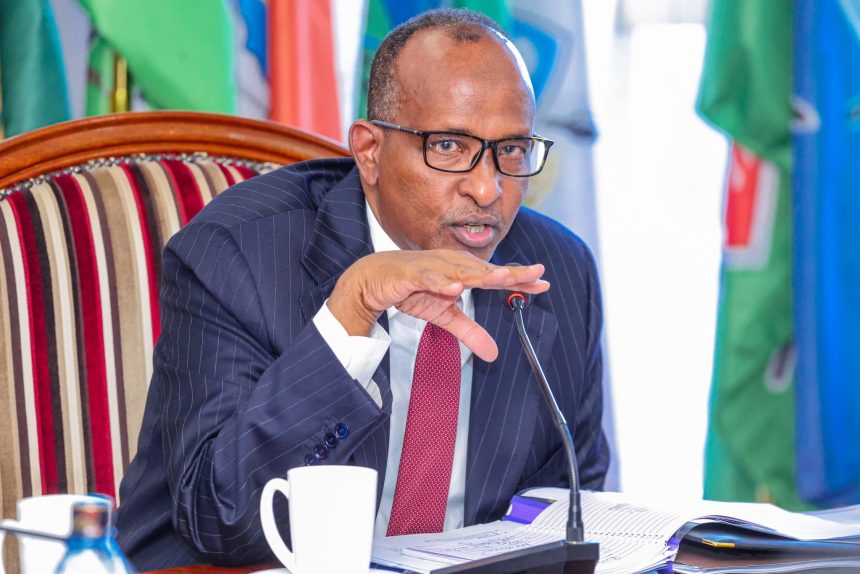
Health Cabinet Secretary Aden Duale has disclosed that the country has recorded a 34 per cent decline in confirmed malaria cases.
Duale said the progress reflects targeted efforts by the Government of Kenya, which is intensifying its drive to eliminate malaria, through greater domestic investment, stronger community health services, improved disease surveillance, and local production of essential health commodities.

According to figures cited by the Health CS, Kenya recorded a significant drop in confirmed malaria cases, from 5.54 million in 2023 to 3.64 million in the year to September 2026.
“Incidence among children under five also decreased from 194 to 119 cases per 1,000,” he added, indicating progress in protecting one of the most vulnerable populations.
However, Duale, who represented President William Ruto at the High-Level Dialogue on Malaria Elimination in Gaborone, Botswana, stressed that sustaining these gains requires adequate and predictable financing. He highlighted Kenya’s substantial shortfall in resources needed to implement its malaria strategy.
“Kenya needs KSh17.7 billion annually to implement its malaria strategy, against the KSh2.66 billion available this year, leaving an 85% funding gap,” he stated.
The funding deficit arises amid increasing pressure on African governments to bolster domestic health financing as international development assistance becomes less predictable.
To address this challenge, Duale noted that Kenya is integrating malaria interventions into its Universal Health Coverage reforms, with investments directed towards community health services, primary healthcare, and digital surveillance systems.
He also said the government is implementing measures to combat antimalarial drug resistance through multiple first-line therapies and enhanced pharmacovigilance, which aims to monitor the safety and effectiveness of malaria medicines.
A key pillar of the government’s strategy is strengthening Kenya’s pharmaceutical and health products manufacturing capacity. This initiative seeks to reduce reliance on imported commodities and improve access to essential supplies.
“Through the Health Products and Technologies Local Manufacturing Strategy, Kenya is targeting local production of 50% of essential health commodities,” he said.
“Our growing capacity to manufacture spatial repellents, with trials showing a reduction in malaria infections of about 33%, demonstrates the potential of African innovation to advance disease prevention,” the CS explained.
Beyond domestic interventions, Duale called for stronger regional cooperation, particularly in surveillance and coordinated responses to cross-border malaria transmission.
He cited Kenya’s collaboration with Uganda on joint surveillance and emphasised the need for greater coordination through the East African Community, acknowledging that malaria transmission transcends national boundaries.
The CS said African countries must strengthen partnerships and collective action to accelerate progress towards malaria elimination, especially as the continent continues to bear a significant share of the global disease burden.