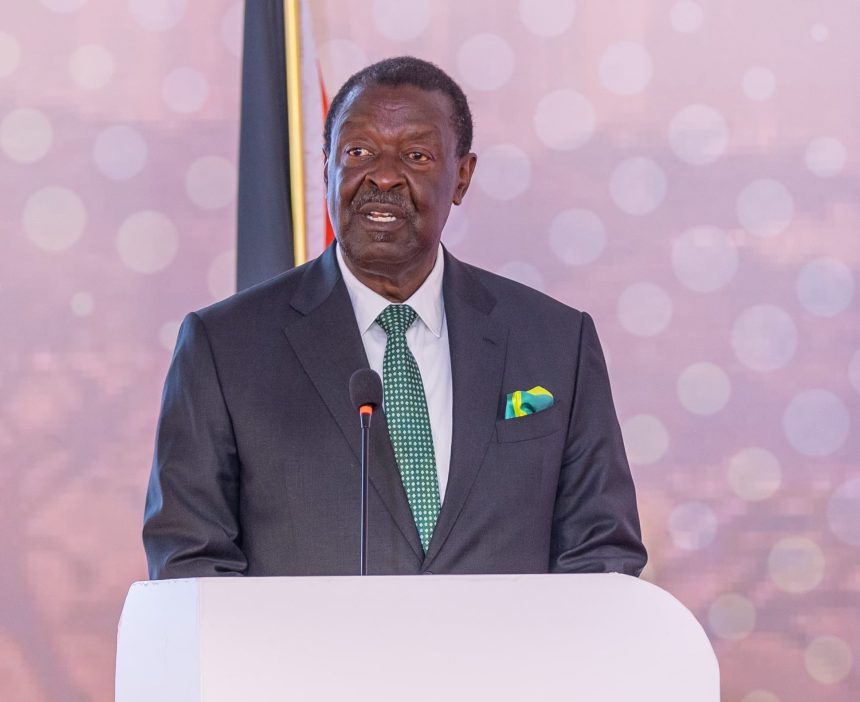
Prime Cabinet Secretary Musalia Mudavadi has urged African countries to increase investment in research, technology and innovation, saying the continent must move beyond importing solutions and become a global producer of technological products and intellectual property.
Mudavadi said Africa had the human capital, expanding markets and entrepreneurial talent needed to compete globally but required sustained investment in research institutions, stronger partnerships with industry and improved commercialisation of homegrown innovations.

Speaking on Thursday, October 22, 2026, during the opening of the Africa Technology Leadership Conference (ATLC) 2026 in Nairobi, Mudavadi called for a coordinated continental strategy to strengthen technological independence and economic competitiveness.
“Africa must move from adopting technology to building technological power,” he said, challenging governments, researchers, investors and businesses to turn existing digital strategies and innovation policies into tangible economic gains.
He noted that African countries had established technology hubs, research institutions and innovation policies but needed to translate these investments into competitive enterprises, quality jobs, intellectual property and stronger institutions.
Mudavadi said technological leadership depended on sustained investment in research and development, warning that countries that failed to build their knowledge base would remain dependent on foreign technologies and expertise.
“We cannot build technological sovereignty on imported knowledge alone,” he said, emphasizing the importance of investing in researchers, universities, laboratories and institutions that transform scientific discoveries into practical solutions.
Citing UNESCO data, the Prime Cabinet Secretary said Africa continued to lag behind other regions in research and development expenditure and the number of researchers relative to its population.
He described the disparity as a challenge requiring urgent action rather than a permanent limitation on the continent’s potential.
“A country that does not invest in knowledge will eventually pay to import the solutions, standards and intellectual property of those that do,” Mudavadi said.
He cited Kenya’s mobile-money platform M-Pesa as evidence that African innovations could achieve global relevance when supported by the right infrastructure and business models.
Launched in Kenya in 2007, M-Pesa expanded access to financial services by enabling millions of people to conduct transactions using mobile phones, including those previously excluded from conventional banking.
“M-Pesa proved that Africa can invent globally relevant solutions and scale them,” he said.
Mudavadi outlined four priorities for strengthening Africa’s technological position, beginning with the integration of science and technology into diplomatic engagement.
He said emerging technologies, including artificial intelligence, biotechnology, cybersecurity and space systems, were increasingly shaping international competition and cooperation.
According to Mudavadi, African diplomacy should facilitate access to research partnerships, scientific infrastructure, technology transfer and global markets while ensuring the continent participates meaningfully in decisions governing emerging technologies.
He cited Nairobi’s position as the only United Nations headquarters duty station in Africa and the Global South as an opportunity to strengthen Africa’s participation in global technology governance.
“Africa must participate in global technology governance as a co-author, not as an afterthought,” he said.
The second priority involves connecting research to capital, industry and markets to prevent promising innovations from stalling before reaching commercial scale.
Mudavadi called on governments to finance strategic research, universities to support commercialization alongside academic publication, and private investors to take a greater interest in intellectual property, software, data and scientific talent.
He also urged development finance institutions to consider appropriate technology-related risks to help innovative businesses grow.
On implementation, Mudavadi warned that expanding digital coverage alone was insufficient unless technology became affordable, accessible and useful to citizens and businesses.
“Coverage is not adoption, digitisation is not transformation, a pilot is not scale,” he said, calling for investment in infrastructure, skills, relevant services and capable institutions.
His fourth priority was building trust, data sovereignty and resilience through regulations that protect citizens while allowing innovation to flourish.
He said African countries needed secure digital infrastructure, stronger cybersecurity and data systems that supported research and enterprise while respecting privacy and national sovereignty.
Mudavadi challenged the conference to establish measurable targets covering research funding, commercialized technologies, mobilised investment, implemented partnerships and the economic value generated.
He also called for continental cooperation through shared standards, interoperable digital systems, cross-border markets and regional research infrastructure.
“Most importantly, we must move from technology ambition to strategic advantage,” he said.
Mudavadi reaffirmed Kenya’s commitment to investing in digital infrastructure, research, skills and innovation while using diplomatic partnerships to expand technological cooperation across Africa.
He said the continent’s young population, natural-resource diversity and growing consumer markets offered opportunities to develop homegrown solutions to economic and social challenges.