Government has called for stronger integration of forest conservation and irrigation development, particularly in the upstream areas of irrigation schemes, to safeguard water availability and strengthen the country’s food security.
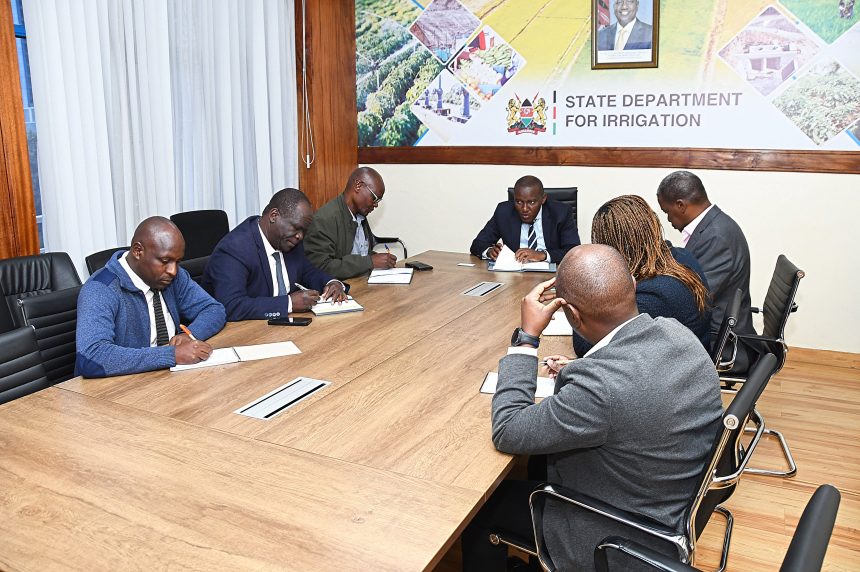
Speaking during a meeting with a delegation from the United Nations Development Programme (UNDP), New Forests and Britam, Principal Secretary, State Department for Irrigation, Ephantus Kimotho noted that the drying of rivers and degradation of water catchment areas continue to pose a challenge to the sustainability of irrigation schemes.

He emphasised the need to restore degraded landscapes and establish adequate buffers around dams and other critical water infrastructure to protect water resources.
“Climate change has made irrigation increasingly critical to ensuring food security, as reliance on rain fed agriculture becomes more uncertain,” the PS said.
Currently, the State Department for Irrigation has developed approximately 760,000 acres under irrigation, while the National Irrigation Sector Investment Plan (NISIP) targets an additional one million acres.
The country’s estimated irrigation potential stands at approximately 2.5 million acres.
The meeting also explored areas of collaboration aimed at promoting sustainable irrigation and strengthening the link between water catchment conservation and irrigated agriculture.
Additionally, the discussions focused on opportunities to integrate forest restoration, sustainable agriculture and irrigation development, particularly through the restoration of degraded land in water catchment areas.
Such interventions are expected to contribute to improved water retention and availability, which are essential for the long term sustainability of irrigation schemes.
The meeting further explored opportunities for farmers in irrigation schemes to diversify their agricultural enterprises through the integration of fruit and tree crops, including avocado, macadamia and coffee, where agro ecological conditions are suitable.
Such approaches could provide additional income opportunities for farmers while supporting landscape restoration and sustainable land management.
Kenya currently has more than 2,000 irrigation schemes, providing significant opportunities for investment in productive and climate resilient agriculture.
Under the five pathways identified in NISIP, irrigation is positioned as a key driver of agricultural productivity, food security and economic transformation. Irrigation schemes such as Galana-Kulalu, Bura and Perkerra continue to demonstrate significant potential for increased agricultural production and investment.
The PS noted that partnerships with development organisations and private sector players will be critical in mobilising resources, expertise and innovative financing for sustainable irrigation development.
New Forests, a natural capital investment manager focused on sustainable forestry and agriculture, brings experience in investments that seek to generate resilient financial returns alongside positive environmental outcomes.
Its engagement with the State Department provides an opportunity to strengthen collaboration on landscape restoration, sustainable forestry and irrigation development.
PS Kimotho reaffirmed the State Department’s commitment to ensuring that the expansion of irrigated agriculture is undertaken in a sustainable and climate resilient manner, with the protection and restoration of forests and water catchment areas remaining integral to the long term success of irrigation investments.
He said the Government will continue to strengthen partnerships that promote sustainable water management, restore degraded landscapes and enhance the productivity of irrigation schemes for the benefit of farmers and the wider economy.